
June 2026 Substack: Healing happens in relationship
The dance between self and co-regulation
17 June 2026
I recently read an article in the Swiss newspaper Tages-Anzeiger (Ich zuerst! Macht uns der Selbsthilfe-Boom zu Egoisten?, 26.04.26 — Me first! Is the self-help boom turning us into egoists?) that struck me as deeply important.
The article is an interview with the Swiss psychiatrist Dr Daniel Hell, in which he speaks about the danger of popular authors' messages (Mel Robbins, Mark Manson, Nedra Glover Tawwab) that setting boundaries and caring less about what others think is the solution to the widespread exhaustion and burnout experienced by many working people.
Pulling my energy inward is an important self-preservation strategy in the face of stress, difficulty, and trauma. It is an intelligent response. But healing also requires connection with others.
As humans, our nervous systems are intimately connected. We see this most strikingly when a parent soothes a child. Or when we step into a room filled with tension and feel it affecting our body, emotions, capacity to think, and ability to connect socially. And some people simply bring a calmness that spills over into others around them. This synchronisation of two nervous systems is called co-regulation (Coregulation: A multilevel Approach via Biology and Behaviour; MH Bornstein, Gianluca Esposito; Children 2023, 10(8), 1323; https://doi.org/10.3390/children10081323).
As humans, we always live within a social context. All our actions—and our inaction—affect both ourselves and others. Setting psychological and physical boundaries is important, but not at the expense of connection. If the me becomes more important than the we, the consequence is separation, fragmentation, and polarisation, which further fuels the spiralling effects of trauma in ourselves and in others.
The resonance I notice with strategies such as setting boundaries, not caring what people think of me, prioritising "me time," and learning to say no, is that they often express an overwhelmed and exhausted society crying out for relief. Our inner experience and outer reality are not separate; they mirror one another. Our personal experiences of exhaustion, anxiety, and uncertainty are reflected collectively in our struggle to hold the uncertainty of the future and in our tendency to seek security through increasingly polarised and fragmented communities.
I am not suggesting that we simply keep going and lose ourselves in relentless demands. We need to step into the driver's seat of the car that represents our lives—to be centred, resilient, and engaged as we actively participate in the flow of traffic.
But how can I rest and recover from exhaustion if pulling back alone will not bring healing? How can my inner wounds heal while remaining disconnected from the wounds around me?
I would describe healing and increasing resilience as having three interrelated dimensions.
First, recovery involves turning our gaze inward and learning to become aware of our physical, emotional, cognitive, social, and spiritual state. This ongoing practice of attuning to our inner landscape is calming in itself. We learn more about how we respond to our environment, about our belief systems, and about our emotional, physical, and behavioural patterns. These patterns were often survival strategies that supported us in the past, but they may no longer serve us in the present. Mindfulness practices and reflective journaling can help loosen the energy trapped within these patterns and allow us to respond with greater flexibility and nuance in the present moment.
Second, an integral part of healing is cultivating a lifestyle that supports the healthy functioning and regulation of both the nervous system and the immune system. The foundations are familiar: sufficient sleep, nourishing food, movement, and healthy social engagement. Most of us know what helps us feel calmer and more restored. For many people, spending time in nature is essential. Others find nourishment through yoga, poetry, dance, singing, gardening, knitting, or participating in a social club.
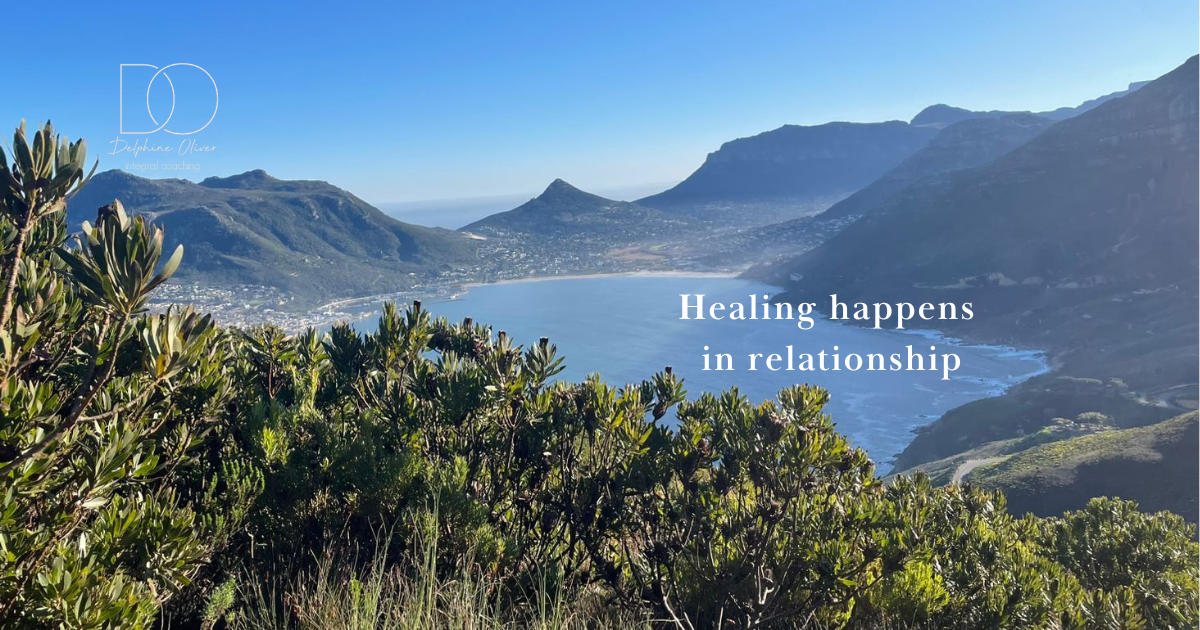
And third, there is the essential dimension of co-regulation. We heal through relationship. Our nervous systems co-regulate and settle. Remaining connected to my inner experience while relating to another person can be deeply nourishing. The healing of both inner and outer wounds happens through relationship. Together, we can stay with what is—the uncertainty, the brokenness—and allow the first next step to emerge (David Whyte, Start Close In). Not a repetition of the step we took before, but something genuinely new. Relating from the place of "I feel you feeling me" may be one of the most nourishing and human experiences available to us. Technology cannot replace this. The risk of not relating is loneliness, illness, and trauma—not only for the individual but also for the people around them. Our future, and our children's future, depends far more on our capacity to relate than on our capacity to produce more goods.
The practice of co-regulation may not be familiar to many people, yet it is fundamental to what makes us human. That is why, together with my friend Megan Adderley, I have started a regular online Thomas Hübl Practice Group, offered free of charge, in which we practise co-regulation through Transparent Communication. Please email me if you are interested in this form of meditative practice (https://pocketproject.org/practice-groups/page/5/#practiceGroupResult).
In my work with individual clients and in the groups I facilitate, there is often a visible pause, a softening, when people learn that nervous system regulation has two interconnected dimensions: self-regulation and co-regulation.
"Ah, so I don't actually have to do it all by myself. I thought I was weak because I couldn't manage by myself."
No, we should not—and cannot—regulate only by ourselves. As humans, we need others to regulate with, and others need us. Regulation is both a personal and a shared practice. This idea can feel radical because sharing our vulnerability with others often feels threatening. So we start small, in contained settings, perhaps with a therapist or coach with whom we feel safe. As we gradually find our centre and increase our resilience, we bring co-regulation into our relationships, creating conditions in which others can heal too.
The experience of exhaustion includes individual, collective, ancestral, and environmental dimensions. Healing and restoration call us to take responsibility for nourishing and enlivening our own inner systems so that we can contribute to healing and restoration within the wider systems that surround us. Through our own growth and development, we become wiser participants in life and more conscious global citizens.
In conclusion, the self-help boom alone is not turning us into egoists. Turning our gaze toward ourselves is an important part of healing. But unless self-awareness is integrated into a relational practice, it can leave us feeling separated and deprived of the life-giving nourishment of human connection.